
Paul Had a Ghostwriter, Too

When I tell people AI helped me write something, I watch them decide whether to be disappointed in me. The assumption underneath is that real authors write every word alone. I believe this is unfortunately yet another example of capitalism, individualism, and a belief in non-existent meritocracy that has crept into the life of the church. It is another insidious idea that is not of God, but of humankind. To see why, we have only to look at the Bible itself.
We have quite a few examples of books in the Bible that were authored by someone other than the person who wrote them out. Paul dictated his letters to a secretary and signed it with his own hand, and nobody has docked him a single point for it. Jeremiah dictated the word of the Lord to his scribe Baruch, who wrote it down with ink on a scroll. In neither case did the hand that held the pen make the words any less the author’s, or any less God’s.
There is a worry that the moment a scribe enters the making, the work stops being fully yours, and might stop being something God could move through. That worry runs especially deep in church people, because we want our words to be honest before we want them to be anything else. But a scribe has never made a piece of writing less the author’s, and a scribe has never once stood between the author and what God was doing through them.
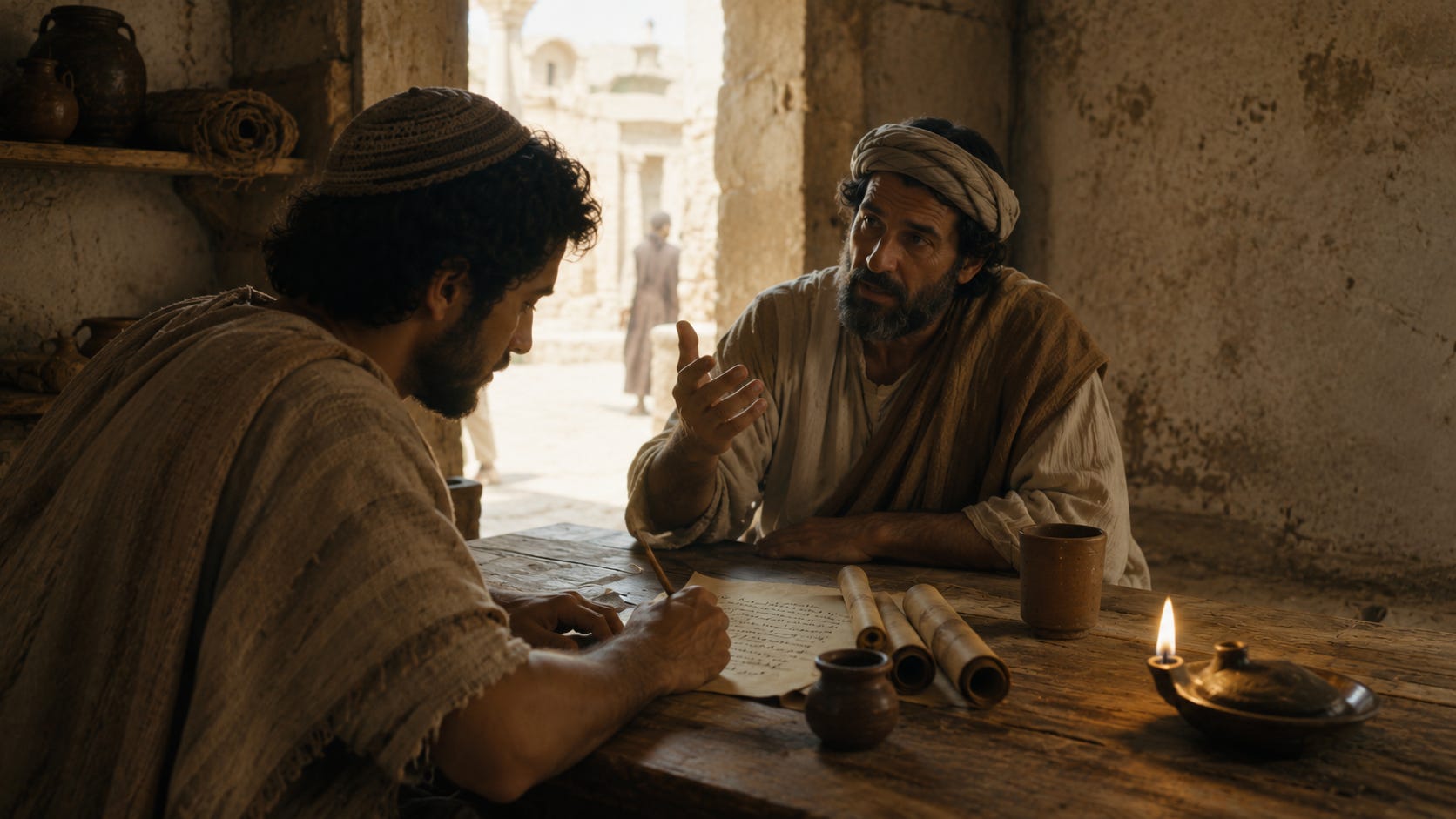
Before I go any further, I want to head off a particular criticism I can hear ringing in my mind: “But the Holy Spirit can move through a human scribe, not a scribe machine!” That may be true. But I am more concerned with whether Paul was inspired by the Holy Spirit when he authored Romans than I am with whether his scribe Tertius was as he put Paul’s thoughts into writing. To say otherwise would call into question why we even care about Paul’s authorship at all.
Perhaps a better way of saying it is this: the Holy Spirit is present in all human labor, regardless of type. And yet, some human labor is automatable, and other types of labor should not be. Since we’ve always cared more about Paul’s authorship of Roman’s than Tertius’ work as his scribe (ask yourself: did you even remember Tertius’ name?), I would suggest that authorship should not be automated, and yet the work of an anamuensis can be without need for concern.
So now let’s talk a bit more about what authorship actually means, if it’s not about writing every word by hand, yourself. Again, let’s look to Scripture for reference.
Some of Paul’s letters he seems to have dictated almost word for word. Others he handed off in looser form and let the secretary do more of the shaping before he approved the result. I know that range from the inside, because it is my own week with these tools. Some days I give an AI a form and almost nothing about myself except the context it’s already acquired and let it answer on my behalf, and the result is fine to send. Other days I sit with it for hours on something that matters, working a single paragraph over and over, and then I put everything in a Google Doc and work on the final draft by hand. My involvement swings as widely as Paul’s did, depending entirely on what the piece is and how much of me it needs.
If Paul could be the author of a letter he labored over for weeks and equally the author of a quick note he barely touched, then authorship was never a measure of how much of the writing he personally performed. The lone-genius picture, where the real author is the one who produced every word unaided, is a modern import that tells us a fanciful tale about what genius and inspiration looks like. It comes from a market that wants to assign credit to a single name and sell it, and it is foreign to the book we claim to follow.
The word itself remembers something better. “Author” comes from the Latin auctor, and an auctor was not mainly the person who made a thing with his own hands. He was the one who stood behind it, who vouched for it, who could be held answerable for it. The same root gives us “authority” and “authorize.” To author a letter was to be the one it answered to, the one who would take the weight of every line. That is why Paul reaches for the pen at the very end and signs in his own large handwriting. The body of the letter is in the secretary’s hand. The signature, and the responsibility it carries, is his.
Jeremiah, a prophet who spoke God’s words to the people, makes the case even clearer: he did not invent the words on that scroll any more than Baruch did. He received them. So what makes Jeremiah the author and Baruch merely the scribe, when neither one originated the content? It is that Jeremiah is the one who answers for the words. He is the one forced into hiding, the one whose name the scroll is read under and whose neck is on the line when a king starts cutting. Authorship turns out to be answerability, even when you did not originate a syllable of what you are answering for. That is the situation of anyone who preaches. You are almost never the origin of the message. It reached you from Scripture and the long tradition before you ever opened your mouth. You are the one who answers for how it lands in the room.
It is worth saying how strange our anxiety would look to the people who gave us the Bible. Much of Scripture is the work of communities and editors rather than lone writers. Stories were carried and reshaped by many mouths before anyone set them down. Psalms were collected over generations. The gospels drew on a common pool of memory and testimony that no single hand owned. The book that formed us did not arrive as the unaided output of solitary geniuses guarding their individual credit. It came as a long collaboration, much of it anonymous, and we have never thought it less holy for that. The idea that a piece of writing only counts when one person produced every word alone would have been close to unintelligible to almost everyone who wrote the texts we read on Sunday. We picked that idea up much later, from a culture that turned the author into a brand and the byline into property. When I feel the urge to apologize for using help, that is the water I am swimming in, and it is not the water of the church.
I don’t want to pretend nothing has changed, because one thing genuinely has. For the entire history of writing, if you wanted a scribe’s hands you also got the person attached to them. Baruch had a conscience and a fear and a place in the story. You could not rent the writing-down without renting a someone who did it. AI is the first scribe that is pure function, the inscribing with no one there to inscribe.
That is what makes it so useful, and it is also why this scribe is dangerous to my authorship in a way Baruch never was to Jeremiah’s. A tool this fast and this tireless, that costs almost nothing and never once looks up from the page, makes it effortless to stop being the author without noticing. You let it generate, skim the result, nod, and send, and at no point did you actually stand behind the words. The pen never came back to your hand. A human scribe kept you honest by sheer friction, because the arrangement was slow and costly and looked you in the eye. This one removes the friction, so I have to put some of it back on purpose. On anything that carries my name in a way that matters, I close the tool and make sure to write the final pass completely by myself. Paul could let his signature be a quick flourish at the bottom of someone else’s handwriting. Mine has to be a discipline, a deliberate climb back into work the machine made it too easy to drift out of.
There is a quieter danger than rubber-stamping, and it takes longer to show. The work of wrestling words onto the page is part of how a preacher becomes someone with anything worth saying. If you let the scribe do all of it, every time, you keep your name on the output while slowly losing the formation that earned anyone’s attention in the first place. A signature stays honest only when there is still a person behind it who has done the kind of struggling that produces conviction. So the final pass I write by hand does more than take responsibility for these particular words. It keeps me the sort of person who can.
Which brings me back to the fear underneath the disappointed look, the one about whether God can still work through writing that had this much help. The tradition could not be plainer. We call Romans inspired, and we have built the better part of Christian theology on it, and it was dictated to a secretary who signed his own name at the bottom. We call Jeremiah the word of the Lord, and it reached us through a prophet’s mouth and a scribe’s ink, and no one has ever imagined that Baruch’s ink made it less God’s word. The Spirit was at work through the author, the one answering for every line, and the question of how the ink met the page sat far beneath that.
You can use a scribe, including this strange new kind, and still be fully the author of what you make, and God can move through you in the writing of it just as God has always moved through people using whatever tools were at hand. If you have been carrying a low hum of guilt about this, the kind that makes you hide the help, I think you can set it down.
But of course, this holds only as long as you remain the one answering for the words. The test is simple. Are you still standing behind what goes out under your name? Keep your hand on that and the help is just help, the way a scribe was always just help. Hand off the answering along with the typing, and you have given away the one thing that made you the author at all.
So when I catch that flicker of judgment now, my own or someone else’s, I don’t argue with it head on. I think about Tertius waving from the bottom of the greatest letter ever written, and Baruch bent over a scroll a king will burn and a prophet will calmly dictate all over again. The lie hiding inside the disappointment, that real work is solitary and a name only counts when one person earned every inch of it untouched, is not the gospel’s idea. It belongs to the culture of our time, dressed up as integrity.