

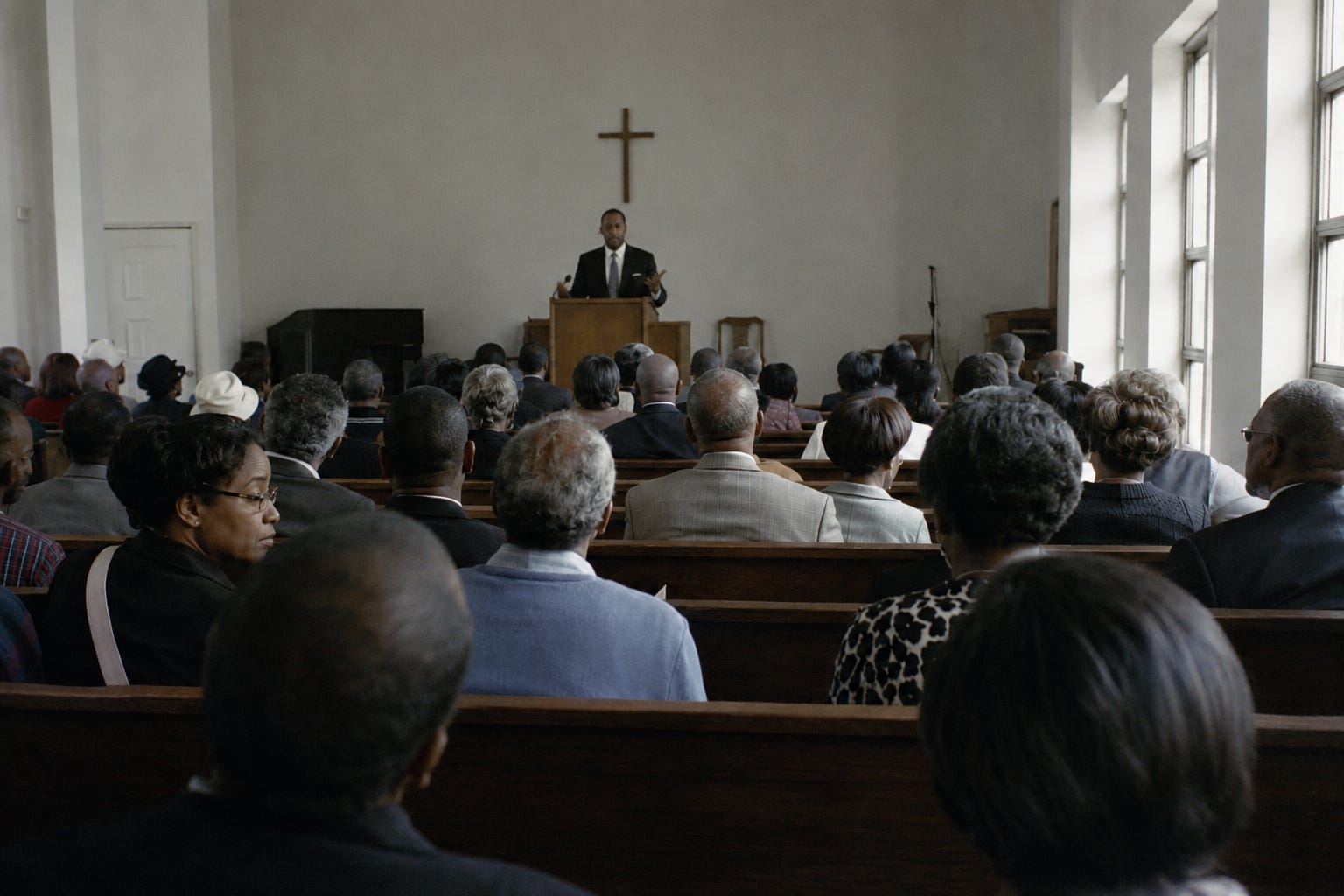
Imagine this: two people in your local congregation. One sits in the pew on Sunday morning and listens while the pastor preaches to the congregation; the other reads the manuscript later that afternoon on the pastor’s Substack. Now ask yourself: which one experienced the sermon as it was shared?
Notice that I’m using deliberately neutral terms like “experienced” and “as it was shared”, which could mean either as it was spoken or as it was written. But if my hunch is correct, nearly everyone would share the same instinct: the person who listened to the preacher live is the one who experienced the sermon. That instinct is in line with the best of the field of homiletics, and it tells us something the current panic about AI keeps missing.
There is a growing discussion underway in the church about artificial intelligence and preaching, and almost everyone in it has quietly assumed the same thing, that a sermon is a text, a document the preacher produces, and that the real question is who or what did the producing. The two-people test I offer says that assumption is off. The Substack reader read the whole text and still didn’t experience the sermon. Whatever the sermon was, it happened in the room, once, and could not be sent out with just words on a page. This distinction between the sermon event and the words on the page is crucial to how I think about AI and sermon writing.
The most recent example of this growing discussion (I wouldn’t go so far as to call it a fight) is a document making its way around clergy circles called the Saint Dunstan Pledge. It was written this spring by the Rev. Emily García, an Episcopal priest in Massachusetts, and posted on the feast day of a tenth-century bishop. Around 150 preachers have signed it so far. The heart of it is a promise to keep generative AI out of sermon work “at any point in the brainstorming, planning, drafting, or writing.” Signers commit to using their own words and to finding and citing their own sources, doing the work by hand.
I want to say plainly that I admire the people who have signed it, and respect their thoughtfulness and dedication to their ministries; and yet, I won’t be signing it myself. I share much of what moves them. I share the conviction that a sermon should never be a polished performance standing in for a pastor’s actual presence. Where I begin to part ways is over a question the pledge never quite stops to ask, which is what a sermon actually is.
A sermon is an event. It is the preacher’s body in the room and the particular morning it is. It is the timing, the held silence before a hard sentence. It is the read of the faces in the third row. It is the congregation’s own listening, which helps make the thing, because a word received is part of what a word is. And it is whatever you want to call the work of the Holy Spirit moving through a living community in real time. None of that lives in the document. All of it lives in the event of the sermon itself.
This is the strange part of the present argument. I think the pledge signers and I actually agree about this. The homiletical mainstream has said for a long time that preaching is an incarnational and sacramental event, that God speaks through a human being’s full humanity in the act of proclamation. I believe that too. It is the ground I am standing on. Though the pledge seems to treat the sermon as words on a page, not a live event, I think most of them would actually agree with what I’m saying here. But if you believe that the sermon is a live event, not words on a page, then certain things have to follow.
What follows is that generative AI cannot take the sermon, and I mean that almost literally. If the sermon is the event and the manuscript is the artifact, then a tool that works on artifacts is working on one side of a gap it has no way to cross. It can help create a sermon manuscript. But it functionally cannot deliver a sermon. The only way a machine could actually deliver the sermon would be for a voice-activated chatbot to be present in the room on Sunday and speak to the gathered people in real time, and nobody serious is proposing that.
We know what that looks like, as it happens, because it has been tried. In 2023 a church in Bavaria handed an entire service over to ChatGPT, sermon included, and let an avatar preach it to a packed room. The only reason people were somewhat impressed was because of the novelty of generative AI at that time, and not because it was a worthwhile worship experience.
The fear that AI is coming to replace preaching is naming a target that I don’t believe actually exists. The real target is AI replacing the work of sermon preparation. Some of the justifications for signing onto the pledge get that distinction muddled. And it’s worth being clear that these are two different things.
The conviction underneath the pledge is that wrestling with Scripture is part of how a preacher is made, that the struggle with the text on Tuesday is itself part of the gift on Sunday. I think that is true, and I am not interested in pretending otherwise. The people in the pews can feel the difference over time.
The temptation to skip the wrestling, though, did not arrive with the chatbot. Preachers have re-preached their own old sermons rather than face a hard week. They have bought sermons, or been offered the use of resources like Sermons That Work for the appointed texts on any given Sunday. They have leaned on a single commentary so heavily that the sermon was really the commentary with a few jokes added. The option to phone it in is as old as the office. So the honest question is what, if anything, is genuinely new here. Plenty of things have always let a preacher skip formation. The chatbot has to be doing something those didn’t, or the alarm is misplaced.
As it turns out, there is something new here. The fears aren’t entirely misplaced, but the true cause for concern could use better definition still. The new thing that generative AI brings, the real change that we need to focus on, is the combination of tailoring and polish without substance or effort.
In the pre-generative AI world, tailoring and polish acted as proxies for substance and effort. Lacking one meant the sermon was half-baked. Preachers who reused a sermon from a previous Sunday or grabbed one from a different context could be spotted whenever the sermon was polished-but-not-tailored. Preachers who prepared a genuinely new sermon but didn’t put enough effort or prayer into their preparations could be spotted whenever the sermon was tailored-but-not-polished.
AI makes it possible to have both tailoring and polish without putting in the effort to make it have any substance. AI can, in a single prompt, write a 1500 word sermon based on a few details about the lectionary text and the current events going on in the community, and it can produce something that sounds like it’s saying something important and relevant for the occasion (at least, to the ear untrained for the tells of AI writing). AI drops the friction of doing this to almost nothing, for any text, every single week. But unskillful, sloppy AI use leads to slop in the pulpit, and that’s something nobody wants. And for those who aren’t listening closely or who aren’t familiar with the tells of AI writing, it’s easy to listen to an entire sermon that sounds like it’s saying something profound when in fact it’s saying nothing at all.
So the real danger that AI brings is the threat of a polished, tailored manuscript that lets a preacher skip the formation and effort and prayer of sermon preparation, and a congregation that doesn’t understand that their preacher is phoning it in.
Let me be clear: I think the Holy Spirit shows up even in sloppy sermons. Even a bad manuscript can lead to lives being changed. But there is an art to preparing a manuscript (which again, is not the sermon), much as there is an art to any other form of creative endeavor. And AI is disrupting what human creativity looks like across the board.
This is where I think the real story is, the part almost none of the pledge conversation has reached. For as long as anyone has preached, polish has been expensive. A well-built sermon meant a human being had put in the hours, knew the text, and cared enough to make the language sing, because you simply could not fake the finish without doing the work. The polish was evidence. We learned, over centuries, to trust it as a sign of the substance underneath, and we were right to, because the link was real and reliable.
That link is what AI breaks. Polish is cheap now, and it has come loose from labor. A sermon can arrive fluent and tailored to your people and still be hollow at the center, and the fluency that used to reassure you tells you nothing anymore about whether anyone wrestled with anything.
So the deepest task of this moment is harder than enacting a blanket ban against AI. It is unlearning an instinct that used to be accurate. We trusted the manuscript because, for most of Christian history, the manuscript tracked the sermon closely enough to stand in for it. We trusted polish because polish tracked substance. Both were proxies we slowly mistook for the real thing. A reliable signal became noise, and now we have to learn to hear past it.
I understand why a pledge feels like the answer. A pledge is concrete. You can sign it today, and you have done something. At its best, a public pledge is itself an act of discernment, a community standing up and saying out loud what it values, and that is exactly the right instinct. My disagreement is with its absolutism, with drawing the line by removing the choice instead of forming people who can make the choice well.
Because the choice is going to be everywhere, and a vow that 150 people take will not change that. What might change it is a church that gets better at telling polish from substance, and that is a skill rather than a slogan.
So come back to the two people from the beginning. The one who read the manuscript that afternoon got an accurate record of the preacher’s notes. The one who was there got the sermon. The words may even be identical. What the page could not carry across was the presence, not just of the preacher but of the people in the room, all of whom were swept up in the movement of the Spirit during the incarnational act of the sermon. The Spirit always shows up, regardless of whether the sermon manuscript was sloppy or half-baked or copied from elsewhere. Thank God for that.
My favorite part of any sermon is the silence between the words. When I'm listening to sermon, I need time to think and absorb what has been said. The silence between the words is what give me time to understand. I'm not sure that AI is good at oratory.
I cannot wait to have further conversations on this with you. I think our beliefs, intentions, and purposes align very closely.