

When the freeways came for the West Village, the people who stopped them were not the ones who had refused to own a car. They were people who knew, in detail, what a road does to a neighborhood. Refusal has never been the same thing as resistance, and the church keeps confusing the two.
The Lower Manhattan Expressway would have run ten lanes through SoHo and Little Italy, and Robert Moses had every institutional advantage on his side. The coalition that beat him, Jane Jacobs most famously, did it by understanding traffic engineering well enough to argue with it, by knowing which hearings mattered, and by describing with precision what an elevated highway does to the street beneath it. They were not innocents. They were people who had studied the thing they opposed.
I keep thinking about that because of a Facebook post I wrote just yesterday, five words long: we must stop racing to superintelligence. A friend replied that this was a strange thing to hear from someone who spends his time teaching clergy to use AI. Another wrote, “I guess we don’t have to use AI,” as though that settled it. Both replies assume I’m contradicting myself. I don’t think I am, and the reason why is worth more than a comment thread.
Here is an analogy I’ve been using to think it through, imperfect as it is, for more than 2 years at this point. Imagine cars arriving in a world with no roads built for them. Car technology is improving rapidly, and currently every car on the market tops out at 40 miles an hour. There’s a priest who’s spent the last two years telling church leaders that it is possible to drive one of these things to get the job of church ministry done without hurting anyone, provided you follow some rules. That’s what an AI literacy workshop is: driver’s education in a world with no stop signs or seatbelts.
Meanwhile, a handful of companies have announced that they are working on building a car that goes 400 miles an hour, and hope to be the first, in a couple years, to have a model that reaches 4,000 (the exponential of AI development played out in car speeds). That same priest could, with perfect integrity, claim that the world is not ready for that car, that no amount of driver’s education makes it ready, and that (for the conceivable future) such a car should never be built.
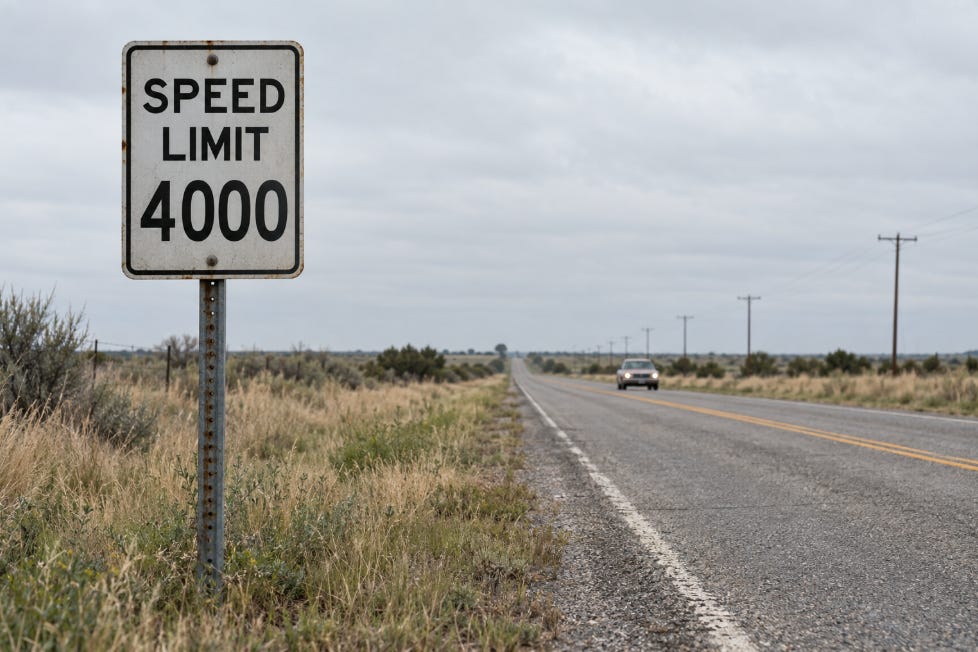
Speed, in this analogy, stands in for intelligence. That’s the whole trick. Both are machines that do one thing on our behalf, move with us or think with us, and both reshape the world around them in proportion to how much of that one thing they produce. A society can decide it wants driver’s ed and also decide it does not want cars that go 4,000 miles an hour, and nobody calls that inconsistent. They are two questions addressed to two different sets of people. The first is for drivers. The second is for manufacturers and regulators.
When I posted the car analogy, a friend answered with a list: pollution, sprawl, the loss of walkable cities, the demolition of poor and minority neighborhoods for interstate right-of-way, wars fought over oil. He meant it as a gotcha moment, pointing out how my analogy proved the cravenness of my argument. But I agreed with every item. I’m a big fan of my e-bike and public transit, and I leave the car in the driveway when I can. I certainly believe that we are far too car-centric as a society. And yet, I wouldn’t go so far as to say that we should all get rid of our cars. What I notice about his list is that not one of those harms was prevented by anyone declining to learn to drive; all of them are solved by better literacy, stricter regulation, and more efficient technology.
The Federal-Aid Highway Act did not pass because too many families had bought a Chevrolet. It passed because people with power decided what the country would be shaped around, and the shaping happened through zoning boards, bond measures, and federal matching funds. Individual abstention had no lever on any of it. The freeways that got stopped, in New York and San Francisco and a handful of other cities, were stopped by people who organized, and organizing required knowing what you were looking at.
A seminarian told me this month that his classmates range from those who use AI for everything to those who have sworn it off and have no idea what it can do. The second group worries me more. They are the ones most likely to believe that their personal refusal is a form of opposition, and they are the ones least able to tell a legislator what should be banned and why. You cannot organize against a car you’ve never seen in action. My workshops are, in part, an attempt to turn people who have sworn it off into people who could testify. Though my primary focus, as it has been all along, is to help the church get ready for superintelligence (for this is where I see the greatest opportunity for my voice to have an impact), a downstream benefit of this is a more informed public that can have more nuanced discussions of regulation.
I’ll acknowledge the strongest version of the objection to my logic: When the church conversation is “here’s how to use it safely,” that conversation smooths adoption. Literacy normalizes use. A priest who learns to draft a newsletter with Claude is one more customer, and customers fund the race. I can’t pretend that’s false. It is the cost of the strategy, and I’ve decided to pay it.
What I get in return is a church that can have more nuanced opinions, and speak the language of those who hold the levers of power. In that same Facebook thread, someone suggested that if the researchers at a single frontier lab organized around safety commitments rather than pay, they could enforce a slowdown faster than any law. I hadn’t heard the idea. It’s the kind of thing you can only invent if you understand where the actual power sits in this situation, and it came from someone who uses and understands these tools intimately. Abstainers don’t produce ideas like that. They produce, at best, a clean conscience.
This is actually one of the best analogies I've heard for a conversation nobody seems to be having. Everyone is so quick to jump on the "for" or "against" bandwagon that no one is actually thinking about what kind of infrastructure and safety is needed for the inevitable.
I've been noticing that the more good people pull out of larger systems in the name of "resistance", the more freedom those in power have to use these systems for destructive purposes and personal gain: politics, religion, technology... virtually every major area of society is ultimately surrendered to bad actors. I think this is what went wrong with social media and I fear we are going the same direction with these new tools that have the potential for far greater harm.
My refusal to drive a regular car won't stop someone from plowing down a crowd of people at 4,000 MPH